Why a Safe Boat Is Not Just a Well-Equipped Boat | BITE
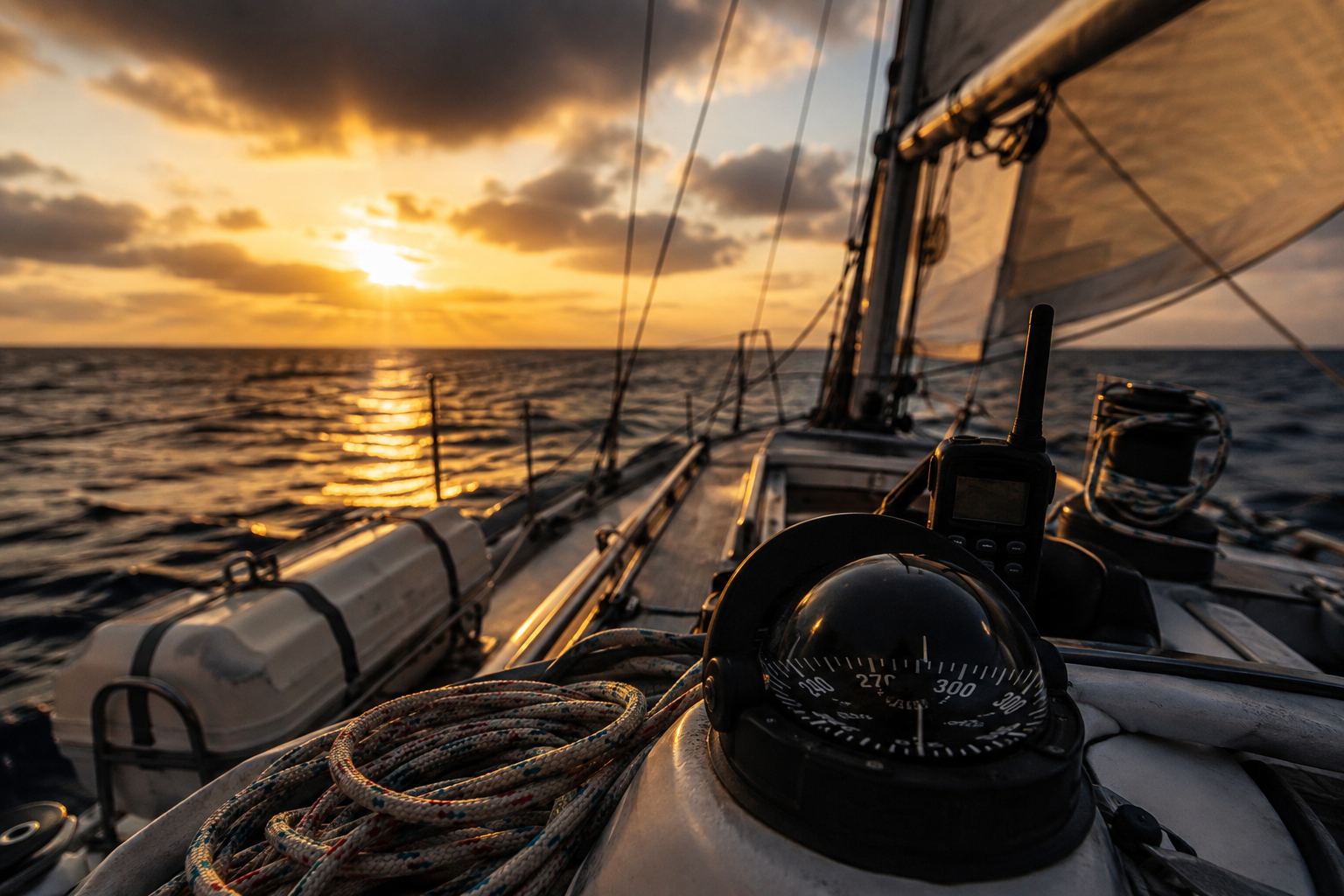
On September 10th we set off from Bari for Lisbon: 2,000 miles, a month and a half at sea. Everyone asked which safety equipment we carry. Almost no one asked how we decide, communicate and react when something goes wrong. This opens a five-part series on boat safety, between equipment and system.
On September 10th Spritz leaves Bari for Lisbon: you'll find the route, the legs and how to join us on board in the article that announced the voyage. Since we published it, and with the chance for some readers to come aboard for part of it, we've had dozens of people write in asking about the boat's safety equipment: how many people the life raft holds, which AIS model we use, whether we carry a fixed VHF radio as well as the handheld one.
They're all fair questions, and we've been glad to answer every one. But almost nobody asked us something else that matters just as much, in our view: how we make decisions on board when something goes wrong, who talks to whom, who has the final say, and what happens in the minutes before a problem turns into an emergency.
It's a harder question to ask, because there's no answer you can photograph the way you can photograph a life raft in the cockpit. And yet, between weeks of route planning, watch schedules and checklists, it's the one we ended up discussing longest while getting ready for this crossing. That's where this article comes from, and the series it opens.
Why we started asking this question
The way readers linked equipment to safety made us notice how common an unspoken assumption is: more gear on board means more safety, less gear means more risk.
It's not an unreasonable way to think. A life raft, a working radio, a functioning AIS can genuinely make the difference in a serious situation. They're essential safety equipment, and in many cases required under applicable regulations: no amount of thinking about human factors can replace them, especially on a crossing that leaves the sheltered Mediterranean and meets proper Atlantic swell.
But we wondered whether equipment alone is enough to say how safe a boat, or a crossing, really is. The idea we kept coming back to while planning this voyage is this:
Safety equipment is part of the safety system. It isn't the whole system.
A life raft needs to be checked, kept accessible, usable by whoever finds it. A radio only helps if the person using it knows when to call and can get the message across clearly. AIS gives you good data, but it doesn't replace a proper lookout, attention, and knowing how to read that data at the right moment.
Here's the sentence that will run through this whole series:
No procedure can make up for missing mandatory equipment, just as no equipment can make up for a crew that doesn't know how to use it.
Neither one replaces the other. They complete each other.
Equipment and system aren't the same thing
Safety equipment is made of objects: a life raft, an EPIRB, AIS, a radio, life jackets, extinguishers. You buy them, certify them, check them on schedule. By nature they're static. Once they're on board and in order, they just sit there, ready.
The safety system is a different animal altogether: it's how people, those tools and the procedures work together, moment by moment.
A small, unremarkable example probably explains this better than any definition. Picture a night watch, moderate wind, nothing unusual going on. Whoever's on watch notices the AIS showing a fishing boat moving in a way that doesn't quite make sense, maybe hauling gear, maybe not, hard to tell. On its own, the AIS gives you a dot on the screen and a projected course. It doesn't tell you whether that boat is about to turn, or whether whoever's steering it has even seen you. What decides whether the answer is "we're fine" or "better wake someone up" isn't the instrument. It's whether the person on watch says something right away instead of waiting to be a hundred percent sure before speaking up. It's a small thing, barely noticeable if nothing comes of it. But that's exactly where the difference shows between having equipment and having a system that makes it useful.
The system is about how roles get split up, how information moves between the people on board, how a doubt gets flagged, how a decision gets made when time is short. It's dynamic. It changes from crossing to crossing, crew to crew, even within the same day at sea. It won't look the same on the calmer leg toward the Balearics as it will on the ocean stretch after Gibraltar.
Readers' questions were almost all about the visible part, the easy part to list. Almost nobody asked how we split roles on board, how we decide things together, or how we notice something isn't going the way we planned. That's not a criticism. It just showed us how often that second, less visible part stays out of the picture.
Something the crew has, not just the boat
The central point of this first article is that safety isn't just something you can check by looking at what's on board. It's also, maybe mostly, something the crew has: how the people on it deal with each other and with the tools they've got.
Take two crews stepping onto the exact same boat, with the exact same gear. If on one nobody's quite sure who's watching the weather or who's on the radio, and a doubt sits unspoken because everyone assumes someone else will bring it up, that crew starts out in a weaker position than one where roles are clear and a doubt gets said out loud without a second thought. The equipment is identical. Everything else isn't.
That doesn't mean equipment doesn't matter. It remains essential to safety, and no talk about human factors makes sense if the life raft is missing or the radio doesn't work. It just means gear alone isn't enough, and that matters even more on a route where the crew changes several times, with friends and readers coming aboard for one leg and stepping off at the next.
Where these ideas come from
While we were sorting out roles, watches and responsibilities for a longer crossing than we're used to, we noticed we were instinctively applying ideas we'd picked up somewhere else entirely, far from recreational boating.
They mostly come from civil aviation and professional shipping, two fields that have spent decades studying what's usually called human factors: how people communicate, split up tasks, and make decisions under pressure. Those fields have courses, certifications, formal procedures. We have none of that, and we're not pretending otherwise. We're not instructors or maritime safety professionals. We're a crew of family and friends getting ready for a longer crossing than usual, and over these past months we've found ourselves reading about, discussing and adapting ideas built for professional settings. What follows in this series is our own take on it, with all the trial and error that implies.
What's coming in the next articles
This first article is the manifesto for the series. It raises the question and lays out the difference between equipment and system. The next four will go deeper, one angle at a time, and each one will stand on its own. We'll be writing them while we get ready for the September 10th departure, and probably still tweaking them once we're already under way to Lisbon.
We'll talk about how a crew actually turns into a team, once skills and information get shared instead of staying locked up in one person's head, an idea that in aviation has a name, Crew Resource Management, with its own version in professional shipping. We'll talk about making better decisions when the pressure's on, and the risk of fixating on one problem while losing sight of everything else. We'll talk about how accidents rarely start with a sudden emergency, and almost always with a chain of threats and errors you can learn to spot and manage in time. And we'll close with communication, starting with what happens inside the boat, among the people on board, since that's the foundation for anything you say to the outside world.
These are tools built somewhere else, in industries with resources, training and rules that recreational boating doesn't have and probably shouldn't try to copy wholesale. We're presenting them here with caution, not as procedures to follow to the letter, but as ways of thinking that might help anyone who goes to sea, us included. We're still learning to put them into practice as we count down the weeks to Lisbon.
The next article picks up right there: how a group of people on board, family, friends, whoever the crew happens to be, maybe changed halfway through the route, actually becomes a team.
So tell us: when you think about safety on a boat, what comes to mind first, the equipment or the way a crew actually uses it? Let us know in the comments, we'd genuinely like to hear how you see it.
Internal links
- Home
- Category: Logbook
- Sails alone
Diego comes aboard with only a few hours' notice, we sail out chased by lightning from a storm, and when the engine dies a few miles from Roccella Jonica, only the sails are left to bring us in.
- The crew before the captain
Spritz's return to the water after her yard work was set for September 8th, but we weren't the first to get there. First of three articles on the real start of the voyage to Lisbon: a fever, two German lads who arrived on schedule, and a boat entrusted to a crew before it even had a captain aboard.
- Communicating When It Really Matters
Communicating isn't just calling for help from outside the boat: it's first about understanding and sharing what's happening inside it. Fifth and final article in our boat safety series: NITS, briefings, debriefs and closing the circle.
- Why Accidents Rarely Start with an Emergency
The emergency is often the last link in a chain of threats and errors recognisable in advance. Fourth article in our boat safety series: Threat and Error Management, explained through a concrete case.
- How to Make Better Decisions at Sea
Faced with a problem, the risk is also fixating on one detail and losing sight of the bigger picture. Third article in our boat safety series: situational awareness, fixation error and the PIOSEE model.
- Safety Starts with the Crew: CRM, Leadership and Communication
A crew is not born a team: it becomes one when everyone's skills and information become available to the group. Second article in our boat safety series: CRM, BRM, leadership and closed-loop communication.