Safety Starts with the Crew: CRM, Leadership and Communication | BITE
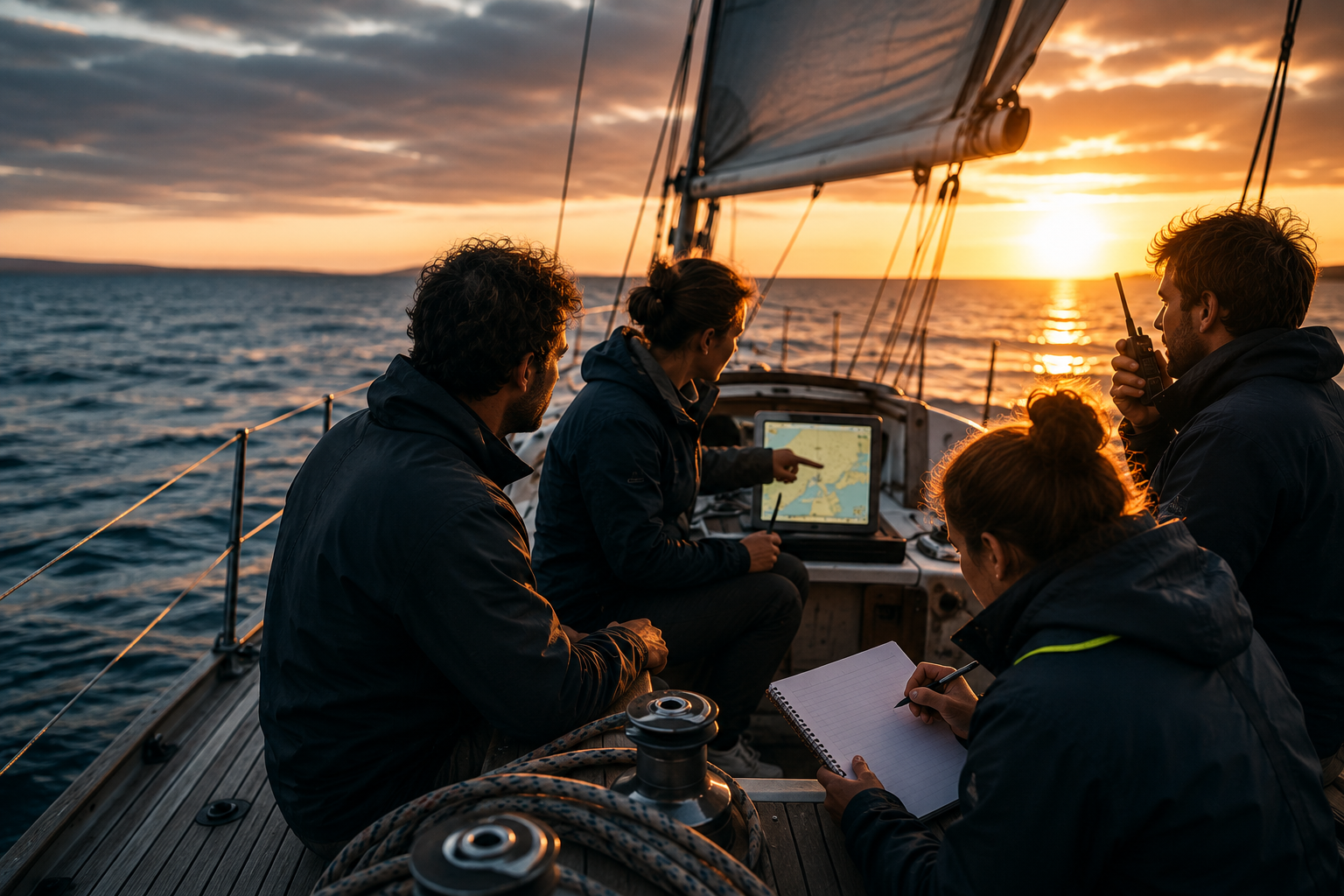
A crew is not born a team: it becomes one when everyone's skills and information become available to the group. Second article in our boat safety series: CRM, BRM, leadership and closed-loop communication.
A crew is not born a team. It becomes one the moment each person's skills and information become available to everyone on board, instead of staying locked inside a single person's head.
In the first article of this series we introduced the distinction between safety equipment and the safety system, along with the sentence that runs through the whole series: no procedure can make up for the absence of mandatory equipment, just as no equipment can make up for a crew unable to use it. In this article we look at the part of the system that concerns people: how a group of individuals — family, friends, whoever happens to be on board — actually becomes a crew that works together.
It's not about how many people, but how they work together
While planning the route to Lisbon we had to organise watches, roles and responsibilities for a longer voyage than usual, with a crew that will change on some legs. This forced us to be more explicit than usual about something that, on a boat with a fixed, close-knit crew, often stays implicit: who knows what, and how they tell the others.
In civil aviation this principle has a name, Crew Resource Management (CRM): the coordinated use of all available resources — people, tools, information — to fly safely. CRM grew out of the observation that many aviation accidents were not caused by a technical failure or an isolated mistake, but by the fact that important information, held by someone on board, never reached the person who had to make the decision. Professional maritime operations have a direct counterpart, Bridge Resource Management (BRM), designed for a ship's bridge. The details of the two models aren't identical, but the underlying idea that interests us is the same: safety improves when everyone's skills on board are made available to the group, not when they stay isolated.
On board, the person steering may know navigation well; someone else may have mechanical experience; another may be more comfortable with the radio or with mooring manoeuvres. If these skills stay isolated, the group doesn't really benefit from them. If they're shared — simply by saying them, asking for them, making them visible — they become a common resource.
The best individual skill, when isolated, is worth less than a shared skill.
Leadership as clarity, not control
The same principle applies to leadership. We've never understood it as "the skipper knows and does everything": it means stating a plan, assigning precise tasks, but also listening to a doubt without treating it as a challenge, and asking for help when the workload becomes excessive.
While planning the route to Lisbon, for instance, we decided in advance who would handle the weather, who the radio, and who emergency management — not because we need a rigid organisational chart, but so nobody has to figure it out on the spot when it actually matters. This clarity about roles isn't a limit on collaboration: it's what makes collaboration possible. When everyone knows who does what, it's easier for anyone to step in outside their own role when needed, without creating confusion.
Saying things out loud: communication as an intangible piece of equipment
There's one thing that ties shared skills and clear leadership together: internal communication, among the people on board. We're not talking here about radio communication toward the outside — a topic we'll cover in the last article of this series — but about how information flows inside the boat, among whoever is on board at that moment.
We consider it a genuine safety asset, even if an intangible one: it can't be bought, it has no technical spec sheet, but its absence weighs just as much as the absence of a physical piece of equipment. A doubt not shared, an observation kept to oneself because "it's probably nothing," a change of plan not communicated to whoever is on watch: these are all small cracks in the safety system, even when the physical equipment is in perfect order.
Closed-loop communication: two confirmations, not one
One concrete tool we've found useful, worth explaining through an example, is closed-loop communication: a way of communicating in which an order or request is never left unanswered, and the completion of the action is confirmed in turn.
A generic but realistic example:
Skipper: "Marco, get the bow anchor ready and let me know when it's done." Marco: "Copy that, going to prepare the bow anchor." (After completing the task) Marco: "Anchor ready."
There are two confirmations, not one, and it's not accidental redundancy. The first — "copy that, going to prepare the anchor" — communicates that the message was heard and understood correctly, and that the action is about to start: whoever gave the order can focus on something else, knowing that part is being handled. The second — "anchor ready" — communicates that the action has actually been completed, not just started: these are two different pieces of information, and without the second one the skipper has no way of knowing whether the anchor is truly ready or Marco is still halfway through the job.
Without these two confirmations, an order can sit in a grey zone: whoever gave it doesn't know whether it was received, or whether and when it was carried out. In a calm situation it doesn't change much. Under pressure — a tricky mooring, a developing emergency — that grey zone is exactly where misunderstandings are born.
Conclusion: a team is built, not assumed
The central point of this article is that a crew is not automatically a team. It becomes one when everyone's skills are made available to the group, when leadership creates clarity instead of centralising, and when internal communication — even in simple forms like closed-loop communication — reduces the room for misunderstanding.
None of this requires courses, certifications or special equipment. It requires the habit, before setting off, of making explicit what often stays implicit: who knows what, who does what, and how we tell each other.
In the next article of this series we'll look at what happens when, despite all this, a problem actually shows up: how to make better decisions under pressure, and the very human risk of fixating on a single detail while losing sight of the bigger picture.
Internal links
- Home
- Category: Logbook
- Atlantic Bound!
Linked voyage
- Sails alone
Diego comes aboard with only a few hours' notice, we sail out chased by lightning from a storm, and when the engine dies a few miles from Roccella Jonica, only the sails are left to bring us in.
- The crew before the captain
Spritz's return to the water after her yard work was set for September 8th, but we weren't the first to get there. First of three articles on the real start of the voyage to Lisbon: a fever, two German lads who arrived on schedule, and a boat entrusted to a crew before it even had a captain aboard.
- Communicating When It Really Matters
Communicating isn't just calling for help from outside the boat: it's first about understanding and sharing what's happening inside it. Fifth and final article in our boat safety series: NITS, briefings, debriefs and closing the circle.
- Why Accidents Rarely Start with an Emergency
The emergency is often the last link in a chain of threats and errors recognisable in advance. Fourth article in our boat safety series: Threat and Error Management, explained through a concrete case.
- How to Make Better Decisions at Sea
Faced with a problem, the risk is also fixating on one detail and losing sight of the bigger picture. Third article in our boat safety series: situational awareness, fixation error and the PIOSEE model.
- The first leg is not a warm-up
Bari–Santa Maria di Leuca: why the first day of sailing already means a full night at sea, and why we're stopping two nights at Leuca before we even need to.