The crew before the captain | BITE
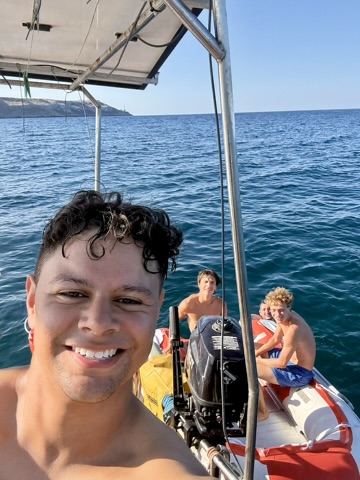
Spritz's launch was set for September 8th, but we weren't the first to get there. First of three articles on the real start of the voyage to Lisbon: a fever, two German lads who arrived on schedule, and a boat entrusted to a crew before it even had a captain aboard.
Spritz was supposed to be launched in Bari on September 8th, and we were supposed to be there to watch her touch water for the first time.
We weren't.
A few days before we were due to leave, I got sick. A real fever, the kind that leaves no room for negotiation: no Bari, no launch, just bed and waiting. For me and my family, the trip slipped by almost a week.
Nepo and Joseph didn't.
The two German lads who'd joined us for the first legs of the route showed up right on time on the 8th, exactly as planned. They found a freshly launched boat and no one there to meet them.
They decided to stay and wait for us. And in the meantime, even though both were total beginners with sailing, they cleaned and prepped the boat on their own. They took delivery of Spritz before we'd even seen her ourselves.
The genoa that wasn't there
We arrived on the 13th. A thorough inspection, a few last-minute fixes, and then the voyage's first real decision, before we'd even cast off a line.
The new genoa we'd ordered hadn't arrived. The question was simple: leave right away with the sail plan we had, slightly undersized, and make the most of what wind was left, or wait for the genoa and risk a brand-new sail and dead calm?
We left. September 15th, finally out of Bari.
We never regretted it.
8.11 knots
Five days of delay cost you at sea: the good wind we'd been counting on had gone with the weather window. But what was left was enough. More than enough.
A hull fresh out of antifouling, all-new rigging: Spritz flew. We hit 8.11 knots, a record for the boat and, technically, faster than a 32-foot hull like ours is supposed to go. Not a bad way to start, genoa or no genoa.
Why Otranto instead of Leuca
The original plan had our first stop at Santa Maria di Leuca. On time, we'd have caught an easterly that would have carried us under sail straight across the Gulf of Taranto to Crotone. With the delay, that wind was gone, and Leuca stopped making sense as a first stop.
There was also a more mundane problem. In the rush to sort out the last details before leaving, we'd forgotten to top up on fuel. Not that we were short, we had enough to reach Crotone under engine. But I never let the tank drop below half: in rough seas the diesel sloshes around, stirs up sediment, and the sediment clogs the filters. To top it off, the trolley we used to haul the jerry cans had broken in Bari, and we'd tossed it out.
Otranto had a fuel station right on the quay. Decided.
There was another reason too, less technical. After 24 hours of straight sailing, stopping for a moment felt sensible: Sami, the dogs and I needed to readjust to offshore rhythms, and for Nepo and Joseph it was their very first time at sea, period. Throwing them straight into two non-stop days felt like too much.
Refuel at Otranto, a second stop nearby for a swim, then the overnight run to Crotone.
An autopilot that never worked
One detail worth mentioning here, because it follows us into every leg after this one: the autopilot doesn't work. We were counting on the wind vane self-steering gear that came with Spritz, never used before. We still haven't managed to get it working properly.
So for the whole voyage, we steer by hand.
The last days together
We still had a reason to hurry: Nepo and Joseph had to fly home on the 20th, and we wanted to reach Crotone with enough margin to give them a couple of days of rest too, after the scramble to leave Bari before a real storm broke over Puglia. We got there on the 17th. Two days ahead.
Those two days at anchor were the voyage's first real breath.
On the evening of the 18th we spent it watching a film projected aboard Spritz, at anchor, under the stars. Not much, but after the week we'd just had, it felt like a celebration.
On the morning of the 19th, Nepo and Joseph left for Germany.
That closes the first leg of the route to Lisbon. Not with us in command from minute one, as you might expect, but with a crew that got there before we did, looked after the boat without anyone asking them to, and stayed with us all the way to the voyage's first real milestone.
A few hours after they left, someone else came aboard Spritz.
But that's another story.
Internal links
- Home
- Category: Logbook
- Atlantic Bound!
Linked voyage
- Communicating When It Really Matters
Communicating isn't just calling for help from outside the boat: it's first about understanding and sharing what's happening inside it. Fifth and final article in our boat safety series: NITS, briefings, debriefs and closing the circle.
- Why Accidents Rarely Start with an Emergency
The emergency is often the last link in a chain of threats and errors recognisable in advance. Fourth article in our boat safety series: Threat and Error Management, explained through a concrete case.
- How to Make Better Decisions at Sea
Faced with a problem, the risk is also fixating on one detail and losing sight of the bigger picture. Third article in our boat safety series: situational awareness, fixation error and the PIOSEE model.
- Safety Starts with the Crew: CRM, Leadership and Communication
A crew is not born a team: it becomes one when everyone's skills and information become available to the group. Second article in our boat safety series: CRM, BRM, leadership and closed-loop communication.
- The first leg is not a warm-up
Bari–Santa Maria di Leuca: why the first day of sailing already means a full night at sea, and why we're stopping two nights at Leuca before we even need to.
- The route on the map isn't the route
How the Bari to Lisbon itinerary came together: the thinking that happened before the chart came out, the changes of mind along the way, and why that line will keep moving.