How to Make Better Decisions at Sea | BITE
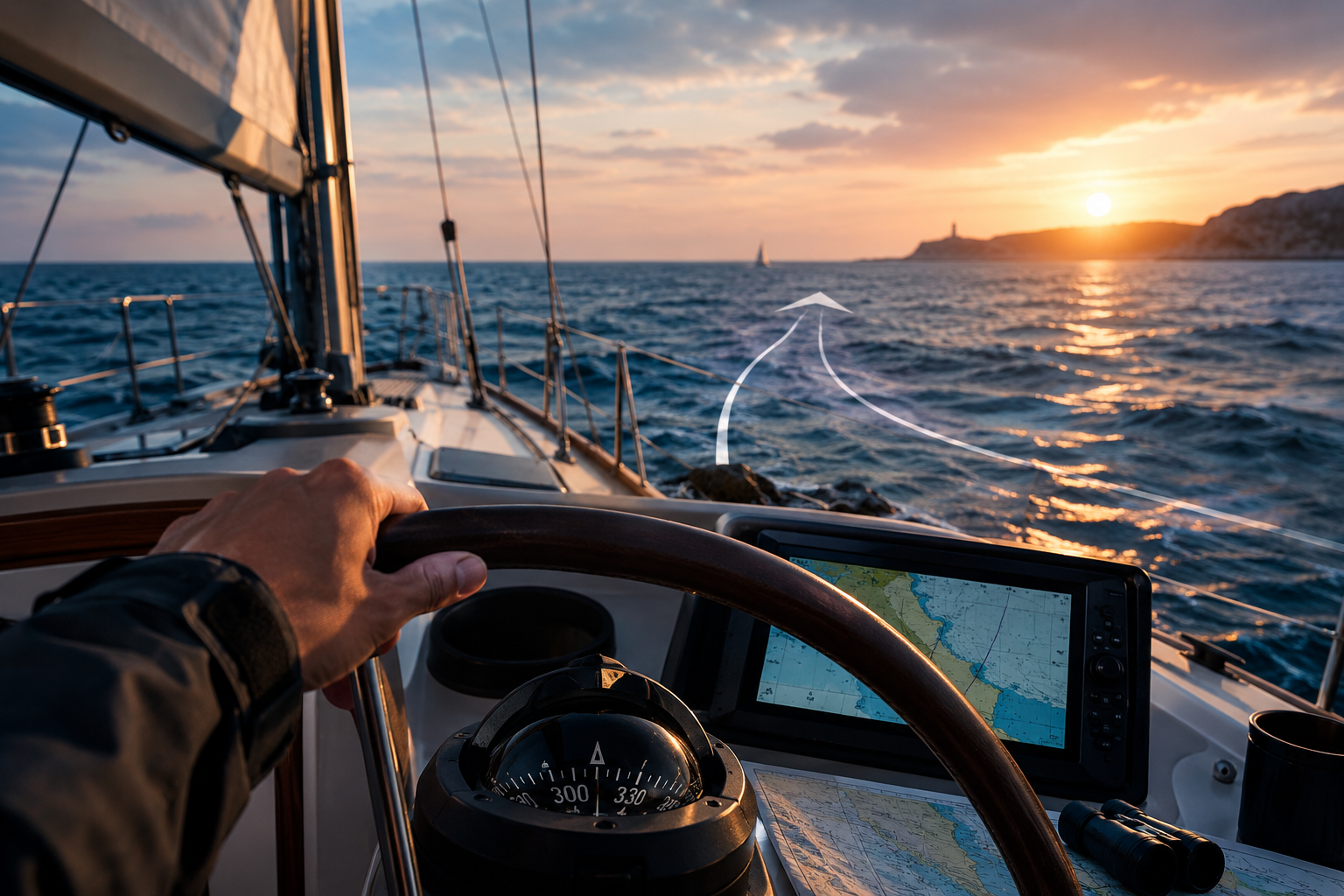
Faced with a problem, the risk is also fixating on one detail and losing sight of the bigger picture. Third article in our boat safety series: situational awareness, fixation error and the PIOSEE model.
Faced with a problem, the most insidious risk is often not the problem itself, but what we do to ourselves: fixating on one detail and stopping seeing everything else.
In the second article of this series we talked about how a crew becomes a team, through shared skills, clear leadership and internal communication. In this article we move into a more specific moment: the one in which, despite all the preparation, something doesn't go as planned and you have to decide what to do, often with incomplete information and little time.
The big picture matters more than the urgent detail
A concept human factors research calls situational awareness describes the ability not to fixate only on the problem right in front of you, but to keep the bigger picture in view: where you are, what other vessels are doing, how the wind is changing, whether someone on board is tired or confused.
It's a simple concept to state and surprisingly hard to maintain under pressure. When something isn't working, attention naturally narrows onto that thing — a useful mechanism, letting us focus on the problem — but if it narrows too much, you risk losing sight of everything else still moving around you. In aviation this phenomenon has a name, fixation error, or tunnel vision: the tendency to concentrate on a single aspect of a problem while ignoring other relevant information or cues that would suggest a different approach.
The danger, in the face of a problem, isn't only the problem itself: it's the tendency to fixate on it while losing sight of everything else.
A question we've repeated to ourselves often, even just mentally during sea trials before departure, is simple: "If we continue like this for another five minutes, what could happen?" It's not a question that solves the problem, but it helps keep peripheral vision open while dealing with the centre.
A method for not jumping from symptom to first action
Situational awareness becomes more useful when paired with a method for deciding, not just for observing. This is where PIOSEE comes in: a decision-making model used in some emergency-management contexts, which we encountered in aviation and present here as a mental reminder, not as an official procedure for recreational boating:
Problem — define clearly what the problem actually is, not just the first symptom you notice.
Information — gather the information available before acting.
Options — weigh more than one option, including ones that aren't the most obvious.
Select — choose the option that seems to offer the greatest safety margin at that moment.
Execute — act, with clear roles on who does what.
Evaluate — check whether the plan is working, and be ready to revise it.
It's not a checklist to recite word for word during a real emergency: it would be unnatural to stop and spell out six words while the boat drifts. Where PIOSEE actually earns its keep is earlier, while there's still time to think: using it in planning, in drills, in lower-stakes situations, until following these steps becomes close to automatic. That's how it really helps you avoid jumping from the first symptom straight to the first action without understanding what's happening, more than by reciting it mid-emergency.
An example: loss of propulsion
Take a case we discussed more than once while planning the crossing to Lisbon: the engine stopping close to the coast.
The risk of fixation error, in this case, is focusing only on restarting the engine (which is natural, since it's the most obvious symptom) and stopping looking at everything else. But the real problem isn't just "the engine has stopped": it's that the boat may drift while dealing with it.
Applying PIOSEE as a mental reminder: the problem to keep in mind isn't just the stalled engine, but what that loss of propulsion brings with it: the boat may start drifting while we're still trying to work out what actually happened (whether it's a mechanical failure, an electrical fault, a fuel leak, or something else). The useful information is position, depth, wind, traffic, distance from hazards. The options range from trying to restart it to preparing the anchor, raising a sail to maintain steerage, calling for assistance or requesting rescue: these aren't mutually exclusive, they're often done in parallel. The choice should fall on whichever option offers the greatest safety margin at that moment, not the most convenient or fastest one to try. Execution requires clarity on who steers, who prepares the anchor, who communicates, exactly the kind of role clarity we discussed in the second article of this series. And finally, you check: is the anchor holding? Is the drift continuing? Is the plan working, or does it need revising?
Conclusion: a good decision preserves margin
A good decision, in our experience, isn't necessarily the fastest one, nor the one that immediately fixes the most visible symptom. It's the one that, even when choosing to act right away, keeps more paths open: maintaining situational awareness and following a method like PIOSEE exists exactly for that, so you don't lock onto a single option before you've actually looked at the whole picture.
It's not a talent you're born with, which is why it's worth training before it's actually needed: on sea trials, in calm moments, in the small everyday decisions on board. That's where you build the habit you can rely on once time is short and information is scarce.
But no decision, however well made, comes out of nowhere: it's almost always preceded by a chain of signals that could have been read earlier. That's exactly where we'll pick up in the next article of this series, to look at how to recognise in time the threats and errors that, left unaddressed, end up turning into an emergency.
Internal links
- Home
- Category: Logbook
- Atlantic Bound!
Linked voyage
- Safety Starts with the Crew: CRM, Leadership and Communication
A crew is not born a team: it becomes one when everyone's skills and information become available to the group. Second article in our boat safety series: CRM, BRM, leadership and closed-loop communication.
- The first leg is not a warm-up
Bari–Santa Maria di Leuca: why the first day of sailing already means a full night at sea, and why we're stopping two nights at Leuca before we even need to.
- The route on the map isn't the route
How the Bari to Lisbon itinerary came together: the thinking that happened before the chart came out, the changes of mind along the way, and why that line will keep moving.
- Welcome aboard Spritz: what it’s like to live on a 32 feet sailboat
Step aboard Spritz, our 1975 sailboat: ten metres that serve as our home, office and travel companion. Here’s what it’s really like to live, work and sail aboard her.
- Spritz is changing seas. And perhaps this is where the real journey begins.
Spritz is setting sail for Portugal, marking the beginning of a new chapter for BITE Project. A real sailing relocation across the Mediterranean and into the Atlantic, open to anyone who wants to experience life aboard, learn by doing, or simply discover whether living on a sailboat is the life they’ve been dreaming about.