Sails alone | BITE
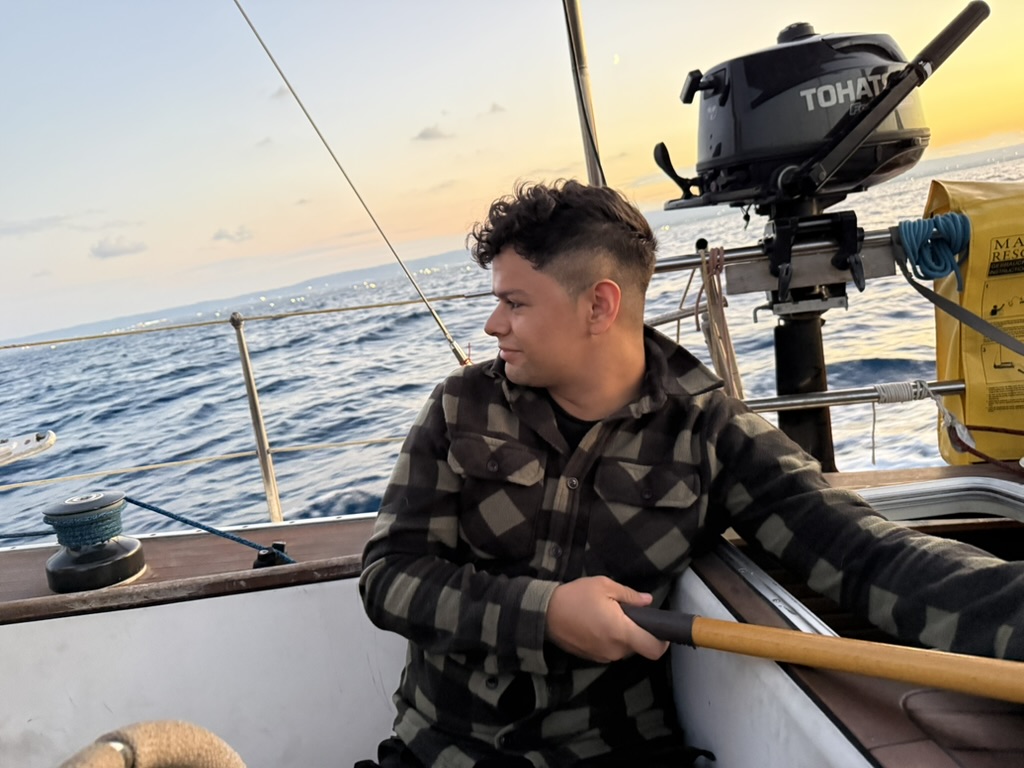
Diego comes aboard with only a few hours' notice, we sail out chased by lightning from a storm, and when the engine dies a few miles from Roccella Jonica, only the sails are left to bring us in.
A few hours after Nepo and Joseph left for the airport, someone else came aboard Spritz.
His name is Diego. He's from Brescia, and until the day before we didn't even know him. He'd messaged us out of the blue, asking if there was room for him on the legs ahead. Within a few hours he'd already booked a ticket to Crotone. The next day he was standing in front of us, backpack on his shoulder.
There wasn't much time for ceremony. A quick rundown of the boat, the essentials, and before sunset we were already out of the harbour, heading for Reggio Calabria.
The storm behind us
The forecast promised little wind and a quiet passage, mostly under engine. We could have waited until morning and left at leisure. We didn't.
Behind us, over Puglia, the storm we'd been racing since Bari was finally breaking. We could see it in the distance, in flashes lighting up the horizon. Leaving right away meant keeping that distance. Waiting meant risking it catching up with us.
So we left.
A better night than expected
For once, the forecast was wrong in our favour. During the night we found far more wind than we'd planned for, and Spritz sailed fast, straight south, with Diego learning to hold a heading in the dark while the rest of us traded off at the helm.
Then, come morning, the wind died. And so did the engine.
A knot and a half
No loud bang, no smoke, no alarm. The engine simply stopped answering. We found ourselves nearly stationary: a few hours adrift, unable to make more than a knot and a half, with the Calabrian coast sitting right there, visible and unreachable.
Eventually a puff of wind showed up. Not much, but enough to carry us into Roccella Jonica, where we came in on the evening of Sunday, September 20th, greeted by fireworks lighting up the sky over the bay.
Sails alone
This part deserves more than a line.
Coming into an unfamiliar harbour, at night, with no engine, isn't just another moment. It's exactly the kind of situation where everything we've written about in the safety series stops being theory and becomes the only thing that matters.
Sami, Diego and I split the tasks as if we'd rehearsed it a hundred times, even though we hadn't: who worked the sails, who called out depth, who tracked our distance from the other moored boats. No raised voices, no confusion, just the sequence of calls and confirmations that turns a manoeuvre like this into something manageable instead of dangerous.
We anchored using nothing but the wind. It went off without a hitch.
The fireworks, we found out later, weren't for us. We liked the coincidence anyway.
A bill still due
We enjoyed that night at Roccella Jonica with the satisfaction of people who'd just pulled off something harder than expected. But a problem was still sitting there, exactly the size of an engine that wouldn't start: we needed to figure out what had happened, and fix it before the real bad weather caught up with us.
That's the next article.
Internal links
- Home
- Category: Logbook
- Atlantic Bound!
Linked voyage
- The crew before the captain
Spritz's return to the water after her yard work was set for September 8th, but we weren't the first to get there. First of three articles on the real start of the voyage to Lisbon: a fever, two German lads who arrived on schedule, and a boat entrusted to a crew before it even had a captain aboard.
- Communicating When It Really Matters
Communicating isn't just calling for help from outside the boat: it's first about understanding and sharing what's happening inside it. Fifth and final article in our boat safety series: NITS, briefings, debriefs and closing the circle.
- Why Accidents Rarely Start with an Emergency
The emergency is often the last link in a chain of threats and errors recognisable in advance. Fourth article in our boat safety series: Threat and Error Management, explained through a concrete case.
- How to Make Better Decisions at Sea
Faced with a problem, the risk is also fixating on one detail and losing sight of the bigger picture. Third article in our boat safety series: situational awareness, fixation error and the PIOSEE model.
- Safety Starts with the Crew: CRM, Leadership and Communication
A crew is not born a team: it becomes one when everyone's skills and information become available to the group. Second article in our boat safety series: CRM, BRM, leadership and closed-loop communication.
- The first leg is not a warm-up
Bari–Santa Maria di Leuca: why the first day of sailing already means a full night at sea, and why we're stopping two nights at Leuca before we even need to.