The first leg is not a warm-up | BITE
Bari–Santa Maria di Leuca: why the first day of sailing already means a full night at sea, and why we're stopping two nights at Leuca before we even need to.
In the last article we left the route where it stands today: still a loose structure, areas rather than exact harbours, an order that seems sensible to us but isn't carved in stone. From here we go leg by leg. We start where everything actually starts: Bari, and the miles that separate our moorings from Santa Maria di Leuca.
Anyone looking at the map for the first time tends to picture the first day as a warm-up. A few hours, the coast always in sight, back in harbour before dark. That's not how we planned it, and it's worth explaining why.
A night, not an afternoon
We plan every leg on the lowest speed Spritz realistically holds, not the average, for the same reasons explained last time. At that speed, the distance to Leuca comes to just over a full day of sailing. In practice you leave Bari in the morning and arrive the following day, with at least one full night at sea in between.
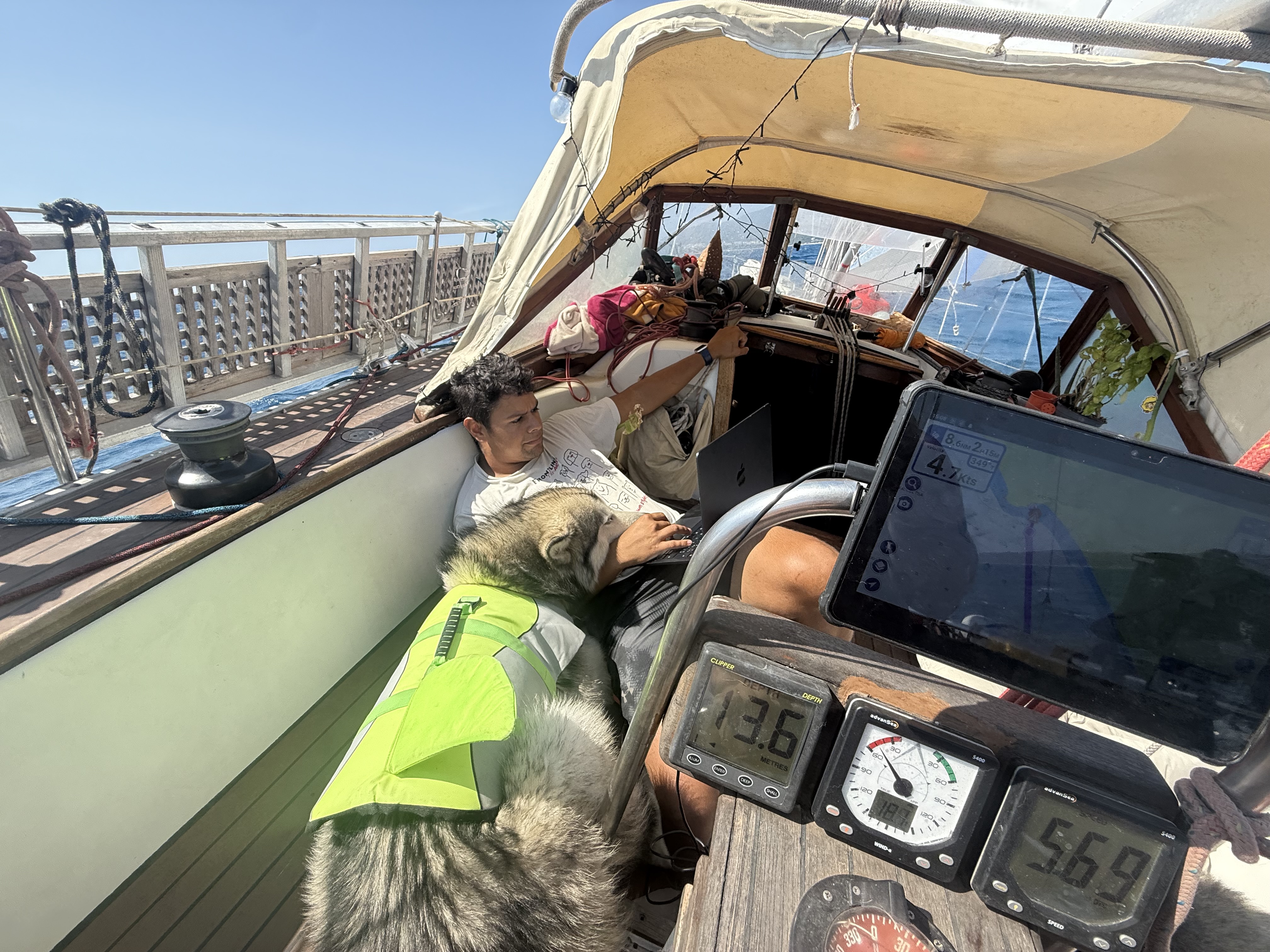
It isn't the longest leg of the trip. But it's the first, and that changes what it weighs. Up to that point Spritz is a boat moored, checked, sorted out at leisure. From that point on she's a boat someone has to sail through the dark, keeping the watches described in the article about living aboard: about three hours when the autopilot can steer, two when someone has to be on the helm. That first night is also the first time that system gets properly tested rather than just described.
Why not a shorter leg
Along the coast between Bari and Leuca there are harbours that would have let us split the crossing into two shorter legs, stopping at Brindisi or Otranto, for instance. We talked about it, and it was one of the few real discussions about this part of the route.
In the end we decided not to stop. The reasoning is that this first leg also serves another purpose beyond moving the boat south: it's the first chance, after departure, to see how boat and crew actually behave in real conditions, not just on paper. Night watches, autopilot, managing fatigue when your body is asking for the opposite. It seems more sensible to find out straight away if something isn't working the way we thought, with Brindisi and Otranto still close enough to retreat to, rather than postponing that test to a more demanding leg later in the trip, when a problem would cost more.
It isn't a certainty, just the reading that convinces us most today. And either way, Brindisi and Otranto stay there on the chart, a real option if something were to go wrong in the first hours.
The last corner of the Adriatic
Santa Maria di Leuca isn't just a convenient point to break the journey. It's also, by tradition, said to be where the Adriatic meets the Ionian: the southern tip of Salento, the last stretch of this coast before the route turns firmly west.
It isn't a technical detail and it didn't shape the choice of this leg more than the logistics already described. But it still marks a threshold. After Leuca the trip stops being the stretch of Puglia many of us already know and starts being something else.
Two nights before we even need them
The planned stop at Leuca is two nights. Not because the harbour needs that much time for fuel or stores or boat work, but because those two nights are meant as margin, not necessity.
In the previous article we talked about weather windows and the fact that the calendar never decides the departure. Here it's the same principle, applied to the first concrete leg. The departure from Bari already has three days of tolerance. If the first stop had zero margin of its own, a delayed departure would automatically become a delay on everything that follows, leg after leg, for the rest of the trip. Two nights at Leuca absorb that risk right away, instead of pushing it further down the line.
If the margin turns out not to be needed, those two nights simply become time to check the boat after her first real night at sea: make sure nothing has worked loose, that consumption matches what we expected, that everything that had to work in the dark actually did. It isn't wasted time either way.
What comes next
From Leuca the route turns into the Ionian, towards Crotone. It's a different stretch of coast from Puglia, with different harbours and different priorities, and at least one choice we argued about longer than this one. We'll get into it in the next article.
Internal links
- Home
- Category: Logbook
- Atlantic Bound!
Linked voyage
- Sails alone
Diego comes aboard with only a few hours' notice, we sail out chased by lightning from a storm, and when the engine dies a few miles from Roccella Jonica, only the sails are left to bring us in.
- The crew before the captain
Spritz's return to the water after her yard work was set for September 8th, but we weren't the first to get there. First of three articles on the real start of the voyage to Lisbon: a fever, two German lads who arrived on schedule, and a boat entrusted to a crew before it even had a captain aboard.
- Communicating When It Really Matters
Communicating isn't just calling for help from outside the boat: it's first about understanding and sharing what's happening inside it. Fifth and final article in our boat safety series: NITS, briefings, debriefs and closing the circle.
- Why Accidents Rarely Start with an Emergency
The emergency is often the last link in a chain of threats and errors recognisable in advance. Fourth article in our boat safety series: Threat and Error Management, explained through a concrete case.
- How to Make Better Decisions at Sea
Faced with a problem, the risk is also fixating on one detail and losing sight of the bigger picture. Third article in our boat safety series: situational awareness, fixation error and the PIOSEE model.
- Safety Starts with the Crew: CRM, Leadership and Communication
A crew is not born a team: it becomes one when everyone's skills and information become available to the group. Second article in our boat safety series: CRM, BRM, leadership and closed-loop communication.