Sailing with dogs isn't the problem it looks like | BITE
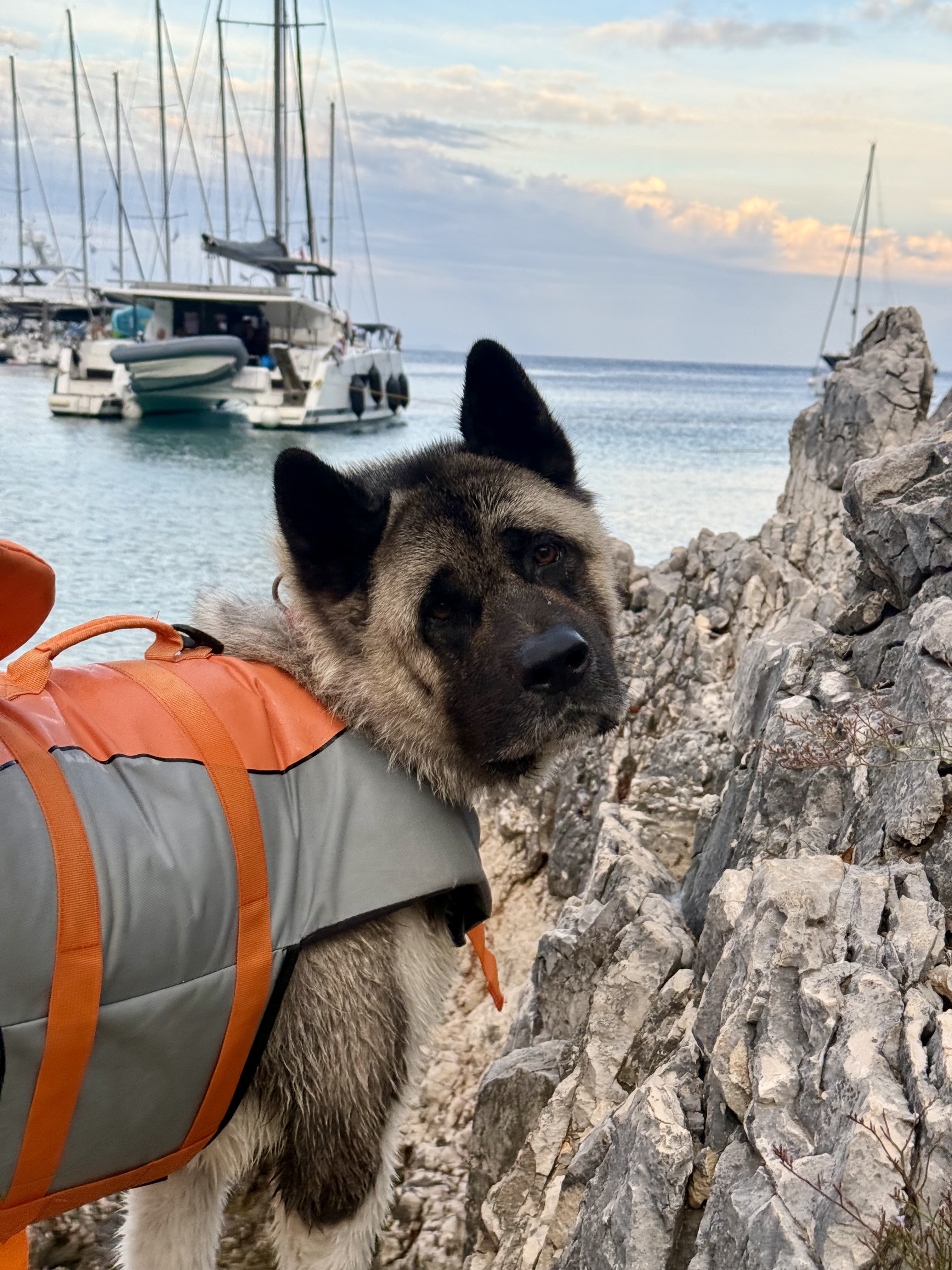
Two large northern dogs on a ten-metre boat: heat, toilet needs, salt, safety, passports. Almost everything people take for granted works the other way round in practice — except one thing.
Everyone asks the same question, and they always ask it first: "Yes, but what about the toilet situation?"
It's the wrong question. Not because it's silly, but because toilet needs are one of the easiest things to sort out aboard. The real difficulties lie elsewhere, and almost nobody names them.
We live on ten metres with two large dogs: Godot, an American Akita, and Freyja, an Alaskan Malamute. Two northern breeds, double coats, serious size. On paper it's the worst possible combination for a sailboat in the Mediterranean. In practice, almost everything we expected turned out to work the other way round.
The heat sorts itself out
The number one worry with two northern dogs is heat. It's also the most overrated.
There's almost always some wind aboard, and that's what makes the difference: a double-coated dog in the sun with a breeze is better off than a dog in the shade in a still city. We say that without exaggeration — we've seen them suffer more in Milan than in Greece in August.
The rest is organising shade. We have a modified balcony parasol, fixed to the mast forward and to the backstays aft: it covers the whole cockpit and, because it hangs down at the sides, it works during the hours when the sun isn't overhead. The solar panel arch shades the stern platform, which has become one of their favourite spots. Under way, there's the shade of the genoa.
But the part that really matters is that they don't need managing. The dogs move around on their own through the day, following the shade, settling wherever the deck is most comfortable. On this they're completely self-sufficient.
Being big is an advantage
The second worry is size. Also the other way round.
From tender to boat and back, they get aboard with a single jump. When we come alongside a beach or a quay, they wait for the command and then jump ashore. They're agile and well balanced, and their bulk helps: they clear gaps that would be a serious problem for a small dog.
What genuinely does get harder with big dogs isn't moving them. It's cockpit space when you need to work the boat — and that brings us to the one part of this article where there's nothing to play down.
Safety, where we don't play it down
If for any reason the dogs are left alone aboard, under way or at anchor, they wear their life jackets.
At the stern we keep an inflatable ramp made to measure for dogs. When we're stopped we leave it in the water permanently; under way it stays within reach, tied with a quick-release knot, so a single pull on the line drops it into the sea, held by a second line so it can't be lost. It isn't an accessory. We run overboard and recovery drills regularly, and not mainly to train ourselves: the real risk, if a dog actually goes in, is panic. The only way to prevent it is for the situation to already be familiar to them.
Then there's the rule we apply most often and that the dogs like least. They feel safe on the boat, and they want to be on deck even when conditions aren't good. Godot in particular is bold enough to try to make his way forward in a rough sea. We rarely allow it, especially under sail: it's safer for them, and it's safer for us, because we need the cockpit clear to work.
On night passages they usually stay below. If the sea is especially calm we let them stay on deck, but with the safety line clipped to the life jacket and no permission to leave the cockpit.
Toilet needs, or the easy question
Which brings us to the question everyone asks.
On deck we keep a piece of artificial grass, a hundred by seventy centimetres. They almost never hit it — they go around it — but it hardly matters: what counts is that they go at all. Then you take a bucket of seawater and rinse the deck down. That's it.
The hard part isn't practical, it's learning, and it doesn't last long. The first few times, Godot held on for nearly a whole day before giving in. Then he understood that when there's no land in sight he can, in fact must, go aboard. Freyja is still a little confused: she goes wherever she happens to be, without overthinking it. On this front she's more hen than dog.
Salt isn't a problem. Rain is.
This is the biggest surprise, and it's worth saying because it goes against what almost everyone assumes.
These dogs' coats, the Akita's especially, are naturally water-repellent. They dry quickly, the salt doesn't stay in, and — the part we like most — they don't smell of wet dog. In this respect they do better than breeds famous for their relationship with water. In summer we rinse them with fresh water when we're in harbour, roughly every week or two, and that's all.
There are a few precautions: we avoid getting them wet close to sunset, and we check they don't stay wet too long, to avoid skin problems. In winter it gets slightly more complicated. But the real enemy, paradoxically, is rain, not the sea.
The concrete problem with a double coat is a different one, and far less poetic: hair everywhere, literally. The cockpit drain filters clog up and have to be cleaned regularly. If we had to name the extra maintenance the dogs cost us, that's it.
Food, water, and stocking up before departure
They eat mainly dry food, in the cockpit, twice a day. Before a long departure we stock up on a few dozen kilos.
There's one piece of advice we'd give anyone travelling with a dog, though: get them used to eating varied food. In another country you never know which brands you'll find, and an abrupt change of diet for a dog used to one single food means stomach trouble, skin problems and uncomfortable days for everyone. Having accustomed them to variety turns a change of brand into a non-event.
Water weighs more than food, in every sense. We carry about fifty litres dedicated to them alone, in separate jerrycans, on top of the boat's tank and our own drinking water. Fifty litres lasts the two of them four or five days.
In harbour they have three bowls: two on deck, forward and aft, ordinary ones, and one below, which is a special one built so the water can't slop out. That isn't a nicety — it's what stops us flooding the bilge.
Passports, vaccines, insurance
Both have European pet passports and rabies vaccinations. That's the minimum, and it isn't always enough: some countries require additional treatments or specific conditions, even inside the European Union. So the rule is to check first, every time.
A concrete example. Entering Norway required an antiparasitic treatment administered no more than five days before entry, which forced us to plan our approach timing carefully. That time we were in a camper, which is far simpler: on a boat, where weather windows decide when you leave, a five-day constraint becomes a real planning problem.
Nobody has ever asked us for dog insurance. We have it for both of them anyway, covering third-party liability, legal costs and veterinary expenses for illness and injury across Europe. With dogs this size, and not always sociable ones, we consider it effectively compulsory.
Aboard we keep medication and first-aid supplies for the most common veterinary situations, chosen together with our vet in a dedicated consultation. For international travel there's one further step few people think about: checking that those medicines can legally be imported into the destination country.
Where they sleep
In good weather, each has their own spot on deck. Godot lies forward, practically over our heads since the owner's cabin is right below — and there are nights we resent him for it, for the click of his nails on the fibreglass. Freyja sleeps in the cockpit. We leave the companionway open so Godot can go below on his own when he feels like it, and he often does: one of the saloon settees has become his.
In winter, when it rains, and on demanding passages, they stay below. Godot on the settee, Freyja on the cabin sole. If the sea is really rough, Godot ends up on the sole too, for obvious reasons.
Character matters more than breed
We'll finish with the one thing you can't buy or organise.
Godot is an American Akita and doesn't know what fear is: he doesn't react to the engine, to sails flogging, to thunderstorms. Freyja, by nature, is far more timid. And yet aboard she's calm, for two reasons: Godot gives her confidence, and the boat is her home.
That's the point we'd leave with anyone weighing up whether to take their dog to sea. Heat can be organised, toilet needs can be taught, salt isn't a problem, paperwork can be researched. What actually changes everything is whether the dog feels at home aboard.
And the nights at sea with them? That's another story, and we'll write it once we've done enough of them.
Internal links
- Home
- Category: Logbook
- Sails alone
Diego comes aboard with only a few hours' notice, we sail out chased by lightning from a storm, and when the engine dies a few miles from Roccella Jonica, only the sails are left to bring us in.
- The crew before the captain
Spritz's return to the water after her yard work was set for September 8th, but we weren't the first to get there. First of three articles on the real start of the voyage to Lisbon: a fever, two German lads who arrived on schedule, and a boat entrusted to a crew before it even had a captain aboard.
- Communicating When It Really Matters
Communicating isn't just calling for help from outside the boat: it's first about understanding and sharing what's happening inside it. Fifth and final article in our boat safety series: NITS, briefings, debriefs and closing the circle.
- Why Accidents Rarely Start with an Emergency
The emergency is often the last link in a chain of threats and errors recognisable in advance. Fourth article in our boat safety series: Threat and Error Management, explained through a concrete case.
- How to Make Better Decisions at Sea
Faced with a problem, the risk is also fixating on one detail and losing sight of the bigger picture. Third article in our boat safety series: situational awareness, fixation error and the PIOSEE model.
- Safety Starts with the Crew: CRM, Leadership and Communication
A crew is not born a team: it becomes one when everyone's skills and information become available to the group. Second article in our boat safety series: CRM, BRM, leadership and closed-loop communication.