We Bought a Boat in Greece (It Went Very Wrong) | BITE
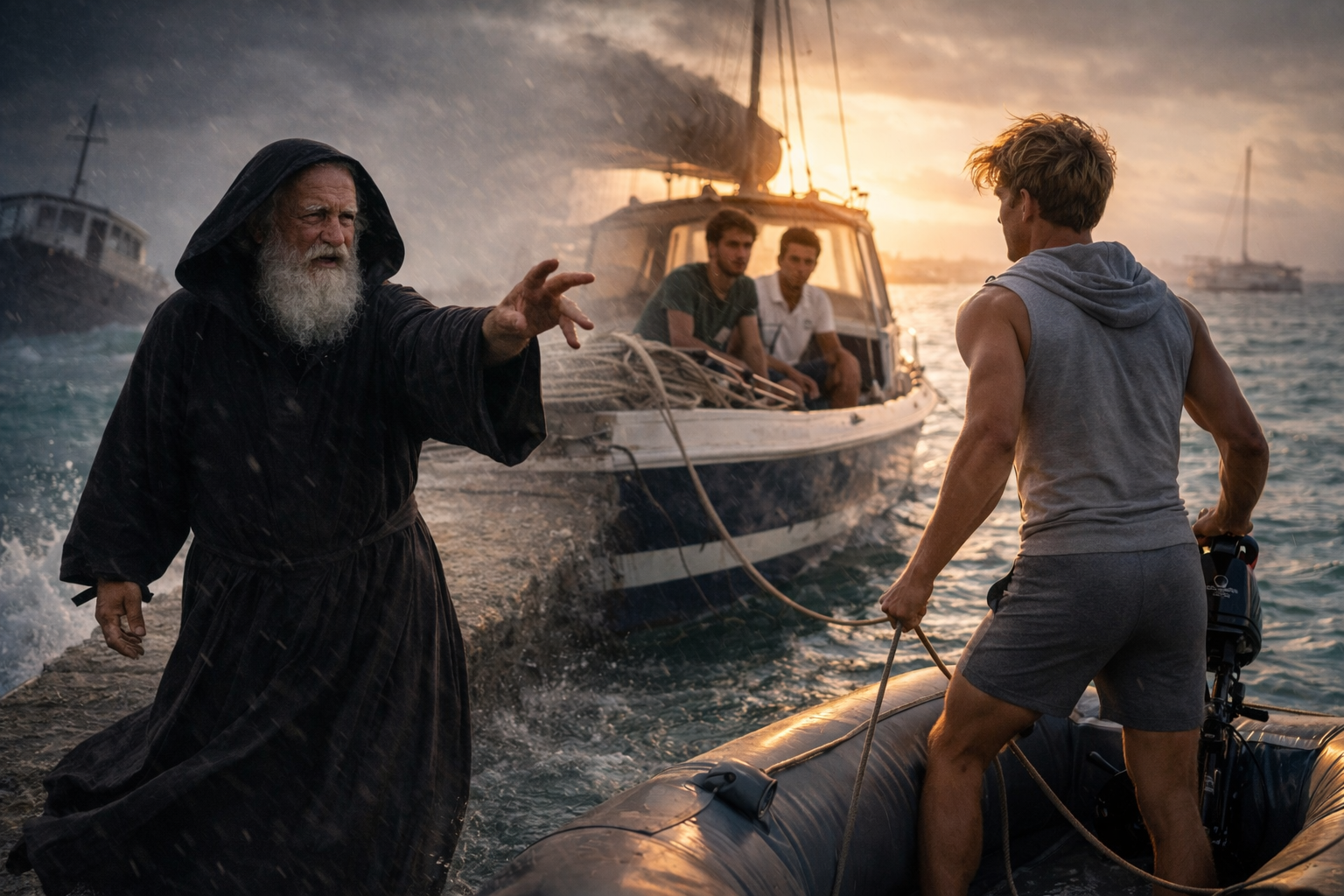
We bought our first sailboat in Greece with no experience and no license, convinced the hard part was already behind us.
Buying your first boat is one of those moments you imagine for years.
You picture freedom, sunsets, new places, and the beginning of a different kind of life.
What you don’t picture is being stopped by the Greek Coast Guard, having your boat put under administrative detention, and being told you can’t leave the country.
And yet… that’s exactly how our first week as boat owners began.
We had just bought our first sailboat
A few days before all of this happened, we bought our first sailboat in Greece.
At that point, we had no real sailing experience, no proper training, and—most importantly in this story—no sailing license.
That last part mattered a lot, because in Greece a license is required to move a boat.
We knew we couldn’t legally sail her ourselves, so the plan was simple: wait for a skipper to arrive and bring the boat back to Italy with us.
In theory, it was a perfectly reasonable plan.
In practice, it unraveled almost immediately.
Waiting in Rafina
We were in Rafina, a port on the east coast of Athens.
It’s not really the kind of place where you stay for long. It’s exposed, functional, and busy—a place where boats and ferries come and go, not where you comfortably sit out bad weather.
But that’s exactly what we had to do.
We were stuck there waiting for the skipper for more than a week, and during that time the weather started to change.
Then one day, the wind picked up hard—around 25 knots, gusting higher—and it was pushing straight into the harbor.
When we got back to the boat, she was slamming violently against the dock.
Not just the kind of bumping that leaves a few marks. Real damage.
The lifelines where the fenders were tied had snapped, and the fenders had fallen into the water. The spare anchor had broken loose from the bow pulpit, dropped onto the bowsprit, and smashed part of the teak covering. The wooden rubbing strake along the side of the hull—basically the boat’s equivalent of a bumper—was heavily damaged.
At first, we tried to save the situation the obvious way: more lines, different angles, more tension, less tension. Anything.
Nothing worked.
At some point it became obvious that staying there was becoming more dangerous than leaving.
So we called the Coast Guard.
No answer.
We called again.
Still nothing.
And that’s when we made the decision that set everything else in motion.
We left.
Crossing the ferry lanes with no idea what we were doing
It was around 5 PM when we untied the lines and left Rafina.
That sentence sounds much calmer than it felt.
To get out, we had to cross the ferry lanes in an active commercial port while ferries were operating at full speed.
We had to improvise a route in real time, with very little practical experience, in rough conditions, while trying not to get pushed into rocks, ferries, or the shoreline by wind and swell.
The waves were around two meters.
And our first objective wasn’t even to go far.
We just wanted to reach a more protected spot nearby: the Rafina Nautical Club.
The Coast Guard boat that wouldn’t help us
Inside the small harbor of the Rafina Nautical Club, we spotted what looked like our best chance: a Coast Guard boat with two officers on board.
At that point, we weren’t trying to “continue the voyage.” We were trying to stop the boat safely.
The problem was that even though the water was calmer inside that harbor, the wind was still strong enough that we couldn’t really stop or hold position.
So we kept moving.
Literally.
We ended up circling inside the harbor in what was basically a figure eight, with Sami at the helm and me on deck shouting “Help! Help!” toward the officers.
We tried to explain the situation.
They never really let us.
Their response, over and over again, was just:
“You can’t stay here. Go away.”
That was it.
No questions.
No attempt to understand what was happening.
And what made it more surreal is that, from our point of view, they had no idea whether we had a mechanical failure, a leak, an injured person on board, or something worse.
They simply didn’t want to know.
We stayed there for almost two hours, circling, asking for help, getting nowhere.
Eventually, we gave up and left.
Night sailing to Artemida
By then, it was getting dark.
We checked the charts and looked for the next possible harbor: Artemida.
On paper, it wasn’t far.
In reality, in those conditions, for us, it felt enormous.
We were still dealing with around 25 knots of wind, gusting to 30, with waves continuing to hit the boat.
We had life jackets on. We were scared. And we were trying to stay in control of a boat we barely knew, in the dark, in rough conditions, with very little idea of whether we were even making the right decisions.
That stretch felt endless.
And then, at around 11:30 PM, we entered Artemida.
And immediately ran aground.
Running aground… and somehow feeling relieved
The harbor was shallower than we realized.
We didn’t see it in time.
And suddenly, after everything else, we were stuck again.
But weirdly, our first emotion wasn’t panic.
It was relief.
Because after hours of being pushed around by wind, waves, and bad decisions, we had finally managed to stop.
Not in the best possible way, admittedly.
But still.
We inflated the dinghy, went to a small restaurant near the harbor, had dinner, and tried to calm down.
Then we went back on board and tried to sleep.
We couldn’t.
Because once the adrenaline dropped, one thought remained:
What if we had damaged the keel?Little did we know this was just the start of it.
Internal links
- Home
- Category: Logbook
- First Time Sailors
Linked voyage
- Arrested by the Hellenic Coast Guard
After a night aground, exhausted and unsure whether we had damaged the boat, we thought the worst was over but then… the Coast Guard arrived.