Arrested by the Hellenic Coast Guard | BITE
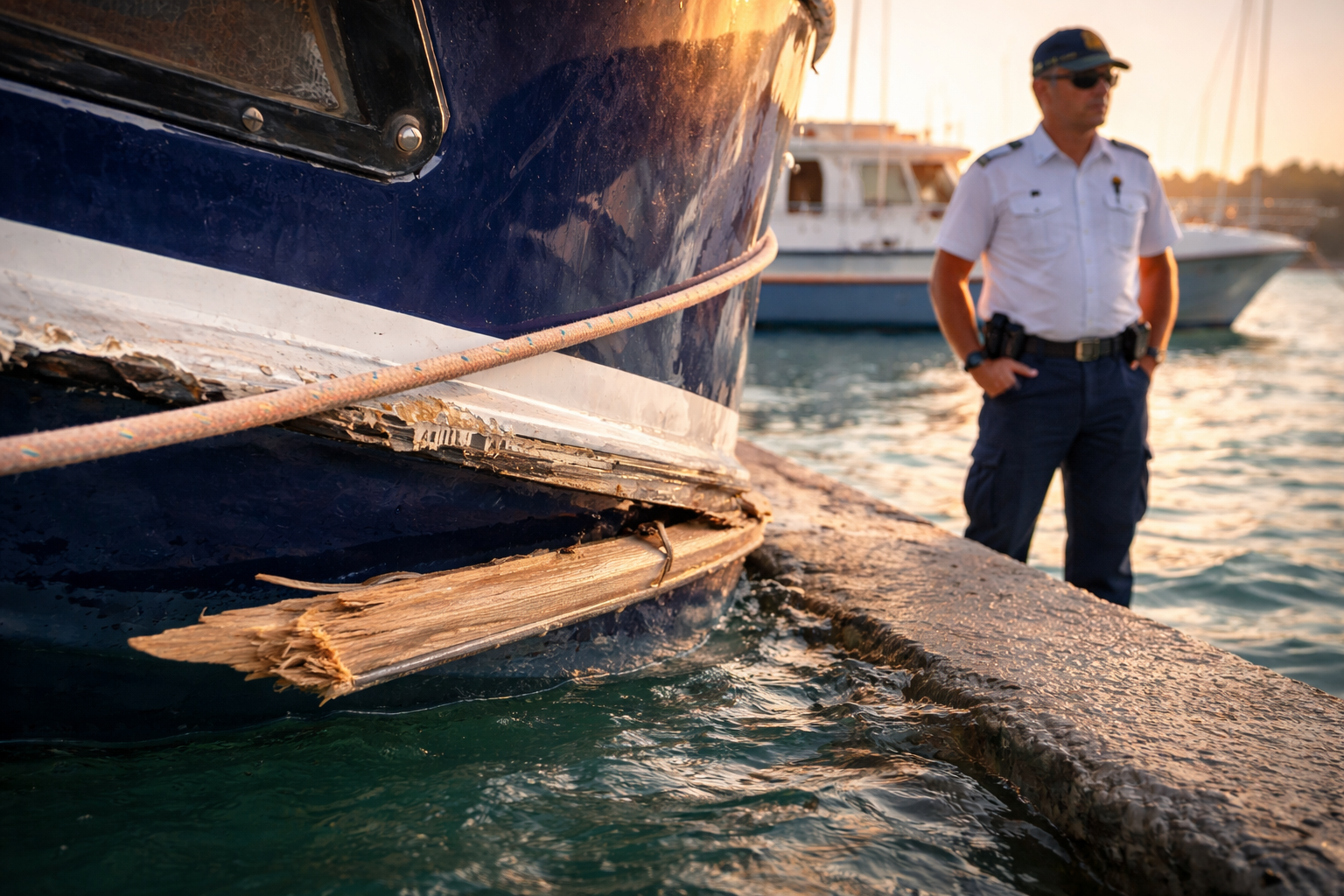
After a night aground, exhausted and unsure whether we had damaged the boat, we thought the worst was over but then… the Coast Guard arrived.
The handsome stranger and the monk
At sunrise, the whole situation took a turn from stressful to almost absurd.
The light was still orange, the harbor was quiet, and we were exhausted and half delirious from the night before.
Then a guy appeared from a nearby boat.
Blond. Very muscular. Light eyes. Wearing a grey tracksuit that, frankly, left very little to the imagination.
He asked if we were aground.
We said yes.
He didn’t hesitate for a second.
He grabbed his dinghy and came to help us.
We, on the other hand, were not especially useful.
At one point, we realized that while trying to help him free the boat, we had somehow left the engine in neutral.
So yes—we were giving throttle enthusiastically while contributing absolutely nothing.
He did most of the work, got us free, guided us toward the harbor entrance… and then disappeared from our lives forever.
We never saw him again.
Still slightly stunned, we moored the boat wherever we could—which, in classic Italian fashion, basically meant double parking next to a half-sunken wreck at the entrance of the harbor.
Then a second mysterious helper appeared.
This one looked like some kind of monk.
Long robe, strong wind, fabric flying everywhere, speaking only Greek and communicating almost entirely through gestures and urgent shouting.
And somehow, with his help, we managed to secure the boat properly.
Then he disappeared too.
At that point, it genuinely felt like we had hallucinated both of them.
When the Coast Guard came on board
That same morning, the Coast Guard arrived.
At first, they were calm.
They asked if we were the boat that had run aground, whether everything was alright, and for my documents.
At that moment, I was alone on deck. Sami was still below.
Then they asked if there was anyone else on board.
I called him up.
And the moment Sami appeared, the tone changed completely.
They became much more serious and started asking for more documents—his ID, his passport, mine again, and then all the boat papers too.
Shortly after that, they asked to come on board for an inspection.
Their explanation was that they needed to verify that there were no illegal passengers hidden on board.
In other words: they suspected we might be smuggling people.
So they searched everything.
Every locker, every compartment, every possible space.
Of course, they found no one.
Then they told us they were sending our details for checks through Interpol and that if there was anything they should know, it would be better to tell them immediately rather than let them find out themselves.
Which is not exactly the kind of sentence that makes you feel relaxed.
Then, after about thirty minutes of oddly normal conversation about food, tourism, and the cost of living between Greece and Italy, they came back with:
“Good news, guys… you’re not criminals.”
At that point, it really felt like it was over.
It wasn’t.
“One more thing… your license?”
Just as they were about to leave, one of them stopped and asked:
“One more thing… can you show us your license?”
We had to tell them the truth.
We didn’t have one.
That’s when they told us to follow them to the port authority office to sign some paperwork.
So we did.
And that’s when another surreal detail revealed itself.
When we got there, we realized that the office they had taken us to was the building directly in front of where our boat had been moored in Rafina the whole time.
We just hadn’t known it.
We waited there for more than two hours.
At first, they said they didn’t know who needed to handle our case.
Then it became clear that this was much more serious than “just paperwork.”
They told us the boat was being put under administrative detention.
They had informed the Italian embassy.
And we were not authorized to leave Greece until the boat had been inspected by a naval surveyor.
Hiring a surveyor to get our freedom back
So we did exactly that.
We found a naval surveyor and asked him to come inspect the boat.
To his credit, he was actually very helpful.
He told us openly that he had already spoken with the commander and knew exactly what kind of report was needed to get the situation resolved.
He checked the hull, the damage to the side of the boat, and—most importantly—the joint between the keel and the hull, to make sure the grounding hadn’t caused structural damage or leaks.
Then he wrote the report.
We paid him €300,00.
And he handed us a survey stating that the boat was in perfectly good condition to continue the voyage.
He sent it directly to the Coast Guard.
At around 10 PM that same evening, they called us and told us to come back the following morning to sign the final paperwork.
Finally, we thought, this is over.
It still wasn’t over
The next morning, we went back.
Everything seemed resolved.
We had already said goodbye.
I had literally touched the door handle to leave.
And then the commander stopped us with one last line:
“But wait… we still have to figure out about you driving without a license.”
So we started discussing.
I argued the obvious: this had been an emergency.
If we hadn’t moved the boat out of Rafina, it could have ended up badly damaged—or worse—right in front of their own office windows.
He, meanwhile, seemed genuinely unsure how to handle the situation.
We were Italian.
The boat was Polish-flagged.
We were in Greek waters.
And in Italy, under certain limits, that same boat could legally be operated without a license.
To me, the legal answer seemed fairly obvious: what matters is the law of the waters you’re in, not your nationality.
But naturally, I had no intention of helping him arrive at that conclusion.
So I leaned into his uncertainty.
Then I told him that if he wanted to fine me, that was fine.
But if he did, he needed to write in the report that we had called for help, received no answer, and then gone to the nearby harbor asking for assistance—only to be sent away by his colleagues.
That changed the atmosphere immediately.
And in the end, they let us go.
No fine.
No charges.
Just one condition: we had to provide all of the skipper’s documents and guarantee that we would not leave without her on board.
We agreed.
And finally, after all of that… we were free.
And that was only the beginning
At that point, we still had to finish provisioning the boat and wait for the skipper to arrive that evening.
And if this story sounds like enough chaos for one trip already…
unfortunately, it wasn’t.
Because once the skipper arrived, things somehow got even worse.
But that’s a story for the next post.
Final thoughts
Looking back, there are a lot of things we would do differently.
Some of them practical. Some of them legal. Some of them just… common sense.
But that first week gave us something useful too: a very fast education in what it actually means to own and move a boat, especially when things stop being theoretical and start becoming real.
If you’re dreaming about buying your first boat, this isn’t a reason not to do it.
It is a reason to respect the gap between “having a dream” and “being ready for the reality of it.”
We learned that gap the hard way.
And in Greece, apparently, with paperwork.
Internal links
- Home
- Category: Logbook
- First Time Sailors
Linked voyage
- We Bought a Boat in Greece (It Went Very Wrong)
We bought our first sailboat in Greece with no experience and no license, convinced the hard part was already behind us.